






CHOOSING MOVING BOXES FOR EASY & SIMPLE MOVING
Introduction
If we're being honest, then it must be admitted that wrapping is often underestimated. This is especially true when it comes to selecting the correct variety of moving boxes. Most people reckon that any old box will do, so they pick up random trolley suitcases without thinking about their consistency, magnitude, or capacity for surviving harsh handling in transit. Unfortunately, such a perception will not only mean you hold items on arrival but can itself lead to stresses and costs that are otherwise unnecessary.
In the whole process of moving, most people tend to concentrate on the big issues; it involves lots of business to make definite Agreements with your archbishop, handle paperwork in depth one way or another, and get ready for your new place. In arranging all this and in going about taking care of that, you tend to overlook the most important item, what it is you're putting into your stuff. But an oversight like this can result in big, productive savings when everything is added up over time.
One slip, and instead of everything being safe and ordered and efficient, your confusion will be multiplied many times at tremendous cost to bear, moving your belongings storewide. The purpose of this guide is to help prepare you for the immediate necessities. With the correct choice in moving boxes, you can avoid breakage, save some time, and get rid of last-minute packing traps, in this way ensuring that your move is just a trifle simpler an operation.
Start With the Basics: Not All Moving Boxes Are the Same
A walk through most moving supply stores will quickly show you exactly how many different types of boxes exist. Once you get past small, medium and large boxes, you will quickly discover that each type of cardboard moving box is built for something different. The wrong box can, and usually does, mean packing disaster.
Standard Boxes: Suitable For General Use
When utilising standard boxes, customers usually associate them with "moving boxes". These boxes cover most of your items. In terms of the box's purpose and general size, here is a simplification:
- A small box is recommended for the heaviest items, such as books, cutlery, canned foods, and tools. For your own safety, and for ease of moving the box, pack it small and ensure the box can be lifted.
- A medium box is an ideal option to pack the highest variety of items. Items such as kitchen gadgets, toys, folded clothes, small appliances, and basically anything that doesn’t have a weird shape or size.
- Large boxes should only be filled with light items. Large boxes will hold big, puffy items, such as pillows, blankets, stuffed animals, or light winter jackets. Large boxes filled with heavy items will only cause your movers to resent you.
- Extra-large boxes follow the same logic. Light items only. Comforters, curtains, lampshades.
Speciality Boxes: Worth Every Rupee
This is where a lot of people skip out to save money and end up paying for damaged goods instead. Speciality moving boxes exist because certain items simply cannot survive a standard cardboard box.
Wardrobe boxes are the ones with a metal rod running across the top. Your hanging clothes go straight from the closet onto that rod. No folding, no wrinkling, no rearranging on the other end. If you have suits, dresses, or anything dry-clean-only, these are non-negotiable.
Dish pack boxes have double-thick walls and are designed specifically to cushion fragile kitchen items. Plates, wine glasses, ceramic bowls, anything that would normally need bubble wrap and prayers. Using a regular box for your good china is just asking for trouble.
Picture and mirror boxes are flat and adjustable. They telescope to fit different sizes, which is convenient. If you have framed artwork or floor mirrors, these will save you a lot of heartache.
TV moving boxes matter if you threw away your original packaging years ago, which most of us have. A proper flat screen TV box with foam inserts is the only safe way to transport a large television unless you want to find out if your warranty covers moving damage.
Plastic Moving Bins: The Reusable Option
Some people prefer plastic moving totes over cardboard, and the reasons are solid. They're waterproof, they stack cleanly, and you can rent them from certain moving companies and return them afterwards. The downside is the upfront cost and the fact that they're heavier even when empty. If you're doing a short local move and want to be eco-friendly, this is worth looking into.
Figuring Out How Many Boxes You Actually Need
Here is a rough estimate that most professional movers go by. Take it as a starting point, not a hard rule, because how much stuff you own varies wildly from household to household.
|
Home Size |
Approximate Boxes Needed |
|
1 BHK / Studio |
15 to 25 boxes |
|
2 BHK |
30 to 50 boxes |
|
3 BHK |
50 to 75 boxes |
|
4 BHK and above |
80 to 100+ boxes |
One thing every experienced mover will tell you: always get more than you think you need. Running short on boxes when you're halfway through packing is one of the most avoidable stresses in any move. Pick up an extra 10 boxes beyond your estimate. If you don't use them all, many stores take unopened ones back.
How to Know if a Box Is Really Good Quality
Not all cardboard is the same, and this is more important than most people think. Cheap boxes literally fall apart when you put pressure on them.
Single-wall boxes are fine for things that aren't too heavy or fragile. You need double-wall corrugated boxes for things that are heavier or more fragile. When you press on the side, you can feel the difference. A double wall is harder to bend and has more resistance.
Check the bottom of the box for a stamp or label. You might see something called an ECT rating (Edge Crush Test) a lot. This number tells you the maximum weight the box can hold before it falls apart. An ECT of 32 or higher is a good standard for moving a normal household.
Check each free-moving box you get from a store or an online group before you use it. Look for soft spots that could mean water damage, tears along the seams, or corners that have already bent and become weaker. A broken box is worse than no box at all because it makes you think you're safe.
How to Find Moving Boxes Without Spending Too Much Time
Getting all new boxes can get expensive quickly, especially for a big house. Here are some real-world places where you can get affordable moving boxes:
- Local grocery and liquor stores often have small, strong boxes that they are happy to give away. Liquor store boxes are great for heavy things because they are made to hold bottles.
- Facebook Marketplace and local WhatsApp groups are great places to find free boxes. People who have just moved often put their boxes out for free pickup. These are usually in good shape because they were only used once.
- Sometimes, online stores like Amazon have bundle deals on moving box kits that come with boxes of different sizes. These deals can be cheaper than buying each box separately.
- A lot of the time, moving companies also sell boxes. If you're already hiring them, it's worth asking if they include boxes in the package.
Packing Your Boxes the Right Way
Choosing the right moving boxes for packing is only one part of the equation. How you pack them is just as important.
Always put a layer of crumpled packing paper at the bottom of any box before adding items. It acts as a buffer against bumps during transit. Don't skip this even if you're in a hurry.
Fill gaps. Any space inside a box means your items can shift around during the move. Rolled socks, dish towels, bubble wrap, and even balled-up newspaper work fine. The goal is that when you shake the box gently, nothing moves.
Don't pack a box so full that it bulges or won't close flat. An overstuffed box is structurally weaker and much harder to stack safely in the truck.
Tape properly. Use quality packing tape and run it along all seams, not just the centre strip. A box with weak taping can open up at the bottom when you pick it up, which is a disaster you do not want to experience while carrying anything fragile.
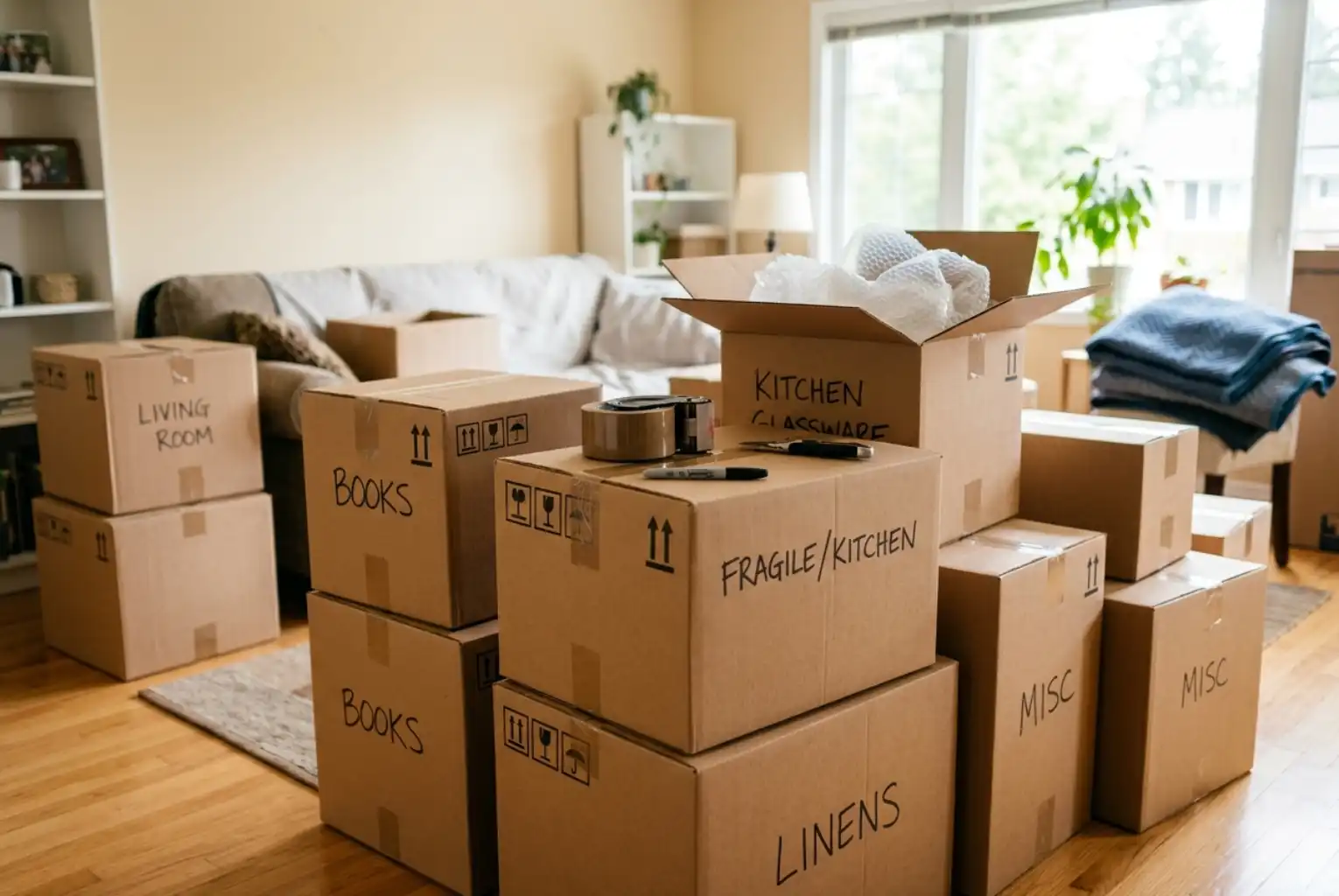
Label every single box, and label it on the side, not just the top. When boxes are stacked, you can't see the top. Writing the destination room and a quick description on the side means you and your movers always know exactly where each box goes without opening everything.
A Few Things People Always Forget
Some items need more thought than others. Electronics like monitors and gaming consoles are better off in their original boxes if you keep them. If not, use appropriately sized boxes with foam padding or wrap the item in clothing before boxing it.
Heavy books are probably the most common packing mistake. One full large box of books can weigh over 30 kilograms. Split them into small boxes, and your movers won't hate you.
Liquids should ideally be transported separately, not packed in boxes with other items. A leaking shampoo bottle can destroy an entire box worth of belongings.
The Right Box Decision Sets Up Your Whole Move
The quality of the moving boxes you choose may not seem like a big deal, but it really does affect how the rest of the move goes. With the right boxes, your things will get there safely, loading and unloading will go more smoothly and quickly, and you won't have to deal with damage, repacking, or stress as often.
Before you start packing, take an extra hour to write down everything you own, figure out what kinds of boxes you need, and find a reliable place to get your cardboard. That hour of planning will save you a lot of time and trouble later, and it will probably keep you from having to deal with things that are broken and can't be fixed.
It's a lot to move already. The boxes shouldn't be the thing that makes it harder.
Our Blogs

BEST COUNTRIES FOR INDIANS TO SETTLE ABROAD: A PRACTICAL COMPARISON
Planning to settle abroad? Discover the best countries for Indians to settle abroad, including Canada, Australia, Germany, the UK, New Zealand, the USA, and UAE. Explore job opportunities, permanent residency options, visa requirements, living costs, and quality of life in each country. This practical guide helps Indian professionals, students, and families compare popular destinations, understand international relocation costs, and choose the right country for a better future. Get useful tips on moving abroad from India, preparing important documents, and planning a safe, smooth, and stress-free international move.

MOVING TO SPAIN FROM INDIA: VISA, COST OF LIVING & RELOCATION GUIDE
Planning on moving to Spain from India? Relocating to Spain can be exciting, but it also requires careful planning for visas, documents, housing, living costs, and international moving. This guide explains the key visa requirements, cost of living in Spain, relocation expenses, shipping options, important paperwork, and practical steps to help you plan a safe and well-organised move from India to Spain.

COST OF LIVING IN BANGKOK: A COMPLETE MONTHLY EXPENSE GUIDE
Thinking of moving to Thailand's capital? The cost of living in Bangkok depends on your area, your food habits, and how you travel. This guide breaks down monthly rent, food, transport, and utility bills in Thai baht and Indian rupees. You will also find sample budgets for budget, comfortable, and high-end lifestyles, the latest 30-day visa-free rule for Indians, common mistakes to avoid, and simple tips to save money before you move.
 Post Feedback
 Gallery
 Awards & Media
 FAQ
FAQ CSR & Sustainability
.svg)