






HOW TO RELOCATE YOUR PET FROM INDIA TO UAE, SINGAPORE OR UK: VACCINES, QUARANTINE AND WHAT NO ONE TELLS YOU
Introduction
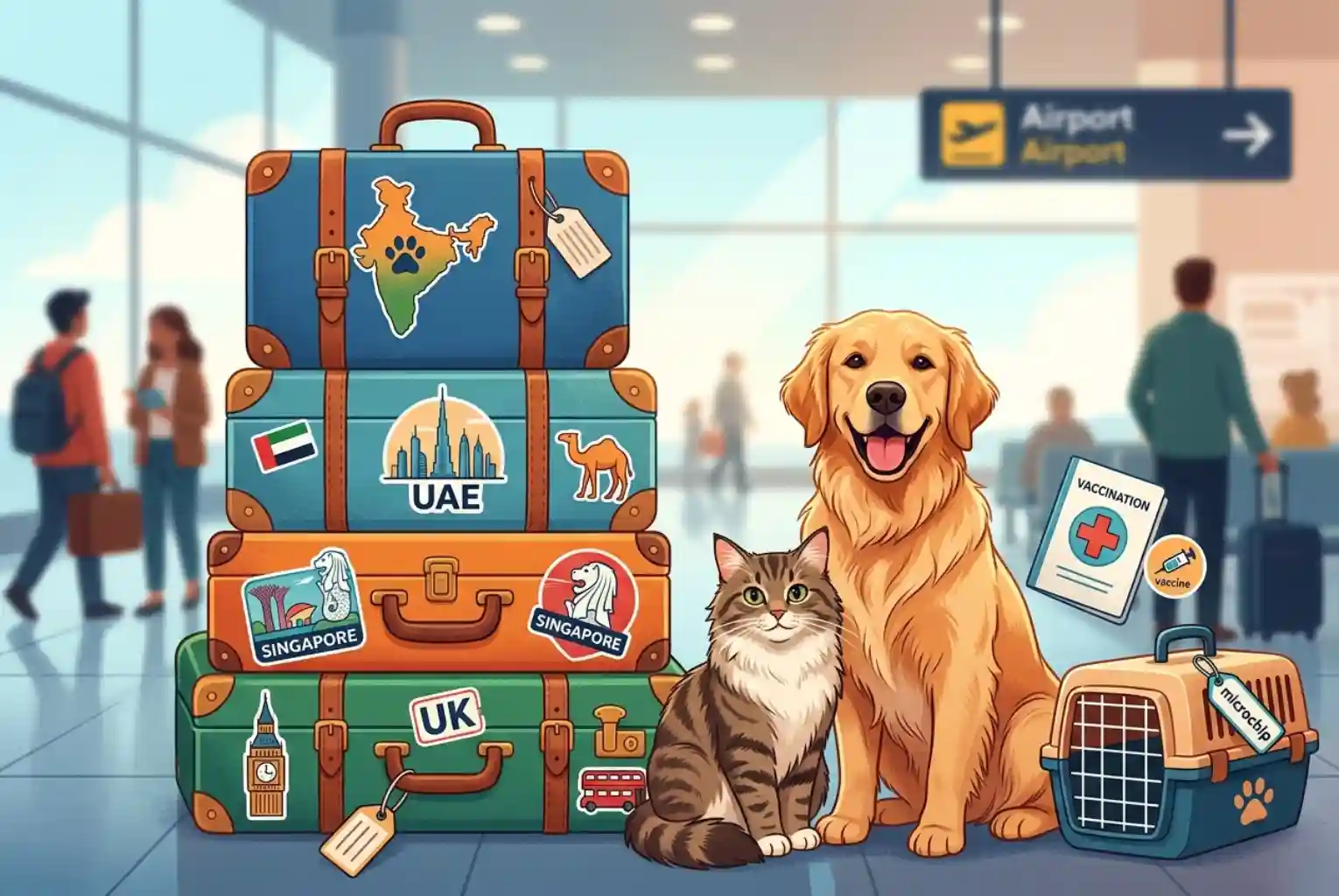
Moving abroad is complicated. Moving abroad with a pet is a different level of challenge entirely. Pet relocation from India involves strict government regulations, precise vaccination timelines, country-specific documentation, and airline approvals, all of which must align perfectly before your pet can board a flight. One missed step can result in your pet being denied entry, placed in extended quarantine, or returned to India at your expense.
This guide covers everything Indian pet owners need to know before relocating their dogs or cats to the UAE, Singapore, or the United Kingdom.
Why International Pet Relocation Requires Early Planning
The biggest mistake pet owners make is treating pet relocation like booking an extra seat on the flight. It is not.
International pet travel from India involves a preparation timeline that can stretch from 6 months to over a year, depending on your destination. Singapore and the UK have particularly strict pre-entry requirements. If your pet has not completed the required vaccinations and tests within the correct time windows, you will miss your travel date, regardless of how ready everything else is.
Start planning the moment you know you are moving abroad. Do not wait until 3 months before departure.
Key Differences Between UAE, Singapore, and UK Pet Import Rules
Each country has its own entry requirements, and they differ significantly.
UAE: The UAE is one of the more accessible destinations for pet export from India. Dogs and cats require a valid rabies vaccination, a microchip, a health certificate issued by a government-approved veterinarian, and an import permit from the UAE Ministry of Climate Change and Environment. Some breeds are restricted, particularly certain aggressive dog breeds. Quarantine is not mandatory for most pets if documentation is in order.
Singapore: Singapore has one of the strictest pet import systems in the world. India is classified as a higher-risk country, which means pets must undergo a mandatory stay at an approved quarantine facility upon arrival, typically for 10 days, at the owner's cost. Documentation must be filed through the Animal and Veterinary Service (AVS), and approval must be obtained before travel. Processing can take 30 to 60 days.
United Kingdom: Post-Brexit, the UK follows its own pet travel scheme. Pets from India must enter via an approved route and through an approved port. A microchip, rabies vaccination, and a rabies antibody titre test are required. The titre test result must show adequate antibody levels, and the pet must wait at least 21 days after a satisfactory result before travel. Tapeworm treatment is mandatory for dogs entering the UK and must be administered within a specific time window before arrival.
Vaccination Requirements Before Pet Relocation
All three countries require a valid rabies vaccination. However, the timing matters.
For the UK and Singapore, rabies vaccination must be followed by a rabies titre test, which measures whether the vaccine produced sufficient antibody levels. The test must be conducted at an approved laboratory. In India, AFOSA and Hester Biosciences are among the recognized laboratories.
The process looks like this: vaccinate, wait 30 days, conduct the titre test, wait for results (usually 10 to 15 working days), and if the result is satisfactory, wait an additional 21 days before travel in the case of the UK. This means the vaccination-to-travel window is a minimum of 3 months.
Core vaccines required across all three destinations typically include Rabies, Distemper, Parvovirus, and Hepatitis for dogs, and Rabies, Feline Panleukopenia, and Herpesvirus for cats.
Microchipping and Rabies Titre Test Explained
Microchipping is mandatory for all three destinations. Your pet must be microchipped before or at the time of the first rabies vaccination. If your pet is vaccinated first and microchipped later, the vaccination is considered invalid and the process must restart.
The rabies titre test (also called RNATT) checks whether your pet's immune system has responded adequately to the rabies vaccine. A result of 0.5 IU/ml or above is generally accepted. A failed test means revaccination and retesting, adding months to your timeline.
Do not skip this step even if the country does not technically mandate it. Airlines and customs officials may ask for the result, and having it avoids complications.
Important Documents Required for Pet Export from India
The following documents are essential for pet export from India:
- Microchip certificate
- Vaccination records with dates and batch numbers
- Rabies titre test report from an approved laboratory
- Health certificate issued by a licensed veterinarian within 10 days of travel
- Endorsement of the health certificate by the Department of Animal Husbandry in India
- Import permit from the destination country (mandatory for Singapore and UAE)
- NOC from the airline for pet travel
- Airline-specific pet travel form
Each country may require additional documents. Verify requirements directly through the official government portals of the UAE, Singapore's AVS, and the UK's APHA (Animal and Plant Health Agency).
Understanding Quarantine Rules Country-Wise
UAE: No mandatory quarantine if all documents are complete and correct. Your pet can be released from the airport on arrival.
Singapore: Mandatory quarantine at an approved facility for most pets arriving from India. Duration is typically 10 days. Cost ranges from SGD 1,200 to SGD 2,000 depending on the facility and pet size.
UK: No quarantine if entry conditions are fully met, including a valid microchip, rabies vaccination, titre test, and for dogs, a tapeworm treatment certificate. Non-compliance leads to mandatory quarantine at a DEFRA-approved facility, which can cost upwards of GBP 1,500.
Choosing the Right Airline and Travel Crate
Not all airlines accept pets on every route, and rules change frequently. Air India, Emirates, Singapore Airlines, and British Airways are among the carriers with established pet travel programs, but each has different policies on cabin versus cargo travel, breed restrictions, and crate dimensions.
For most international routes from India, pets travel as manifest cargo rather than in the cabin. This is not as alarming as it sounds. The cargo hold is temperature-controlled and pressurized. However, it does mean your pet will be alone for the duration of the flight.
Your travel crate must meet IATA-approved pet crate standards. The crate must be large enough for your pet to stand, turn around, and lie down comfortably. It must have proper ventilation, a secure latch, a water container attached inside, and absorbent bedding. Do not buy a cheap plastic crate hoping it will pass inspection. IATA-compliant crates from approved brands are worth the investment.
Preparing Your Pet Physically and Emotionally for Travel
Start crate training at least 4 to 6 weeks before travel. Let your pet sleep and eat inside the crate so it becomes a familiar, safe space. A stressed pet is more likely to injure itself or refuse food and water during transit.
Avoid sedating your pet unless explicitly advised by your veterinarian. Sedatives can affect a pet's balance and respiratory function at altitude, which increases risk during long flights.
On travel day, feed your pet a light meal 4 hours before departure. Keep water available until check-in. Attach a small bag of food and feeding instructions to the crate in case of delays.
Common Mistakes Pet Owners Make During International Relocation
The most common and costly mistakes include:
- Getting the pet microchipped after the first rabies vaccine instead of before
- Starting the titre test process too late
- Using a non-endorsed health certificate
- Choosing the wrong crate size or a non-IATA-compliant crate
- Not applying for the import permit early enough, particularly for Singapore
- Missing the tapeworm treatment window for UK travel
- Booking a transit flight that stops in a country with its own pet entry rules
Hidden Costs Nobody Talks About
Most pet owners budget only for the airline pet fee. The actual cost of pet relocation from India includes:
- Veterinary fees for vaccinations, titre tests, and health certificates
- Government endorsement fees
- Import permit fees
- IATA-compliant crate purchase
- Airline pet cargo charges (can range from INR 20,000 to INR 80,000 depending on route and pet weight)
- Quarantine facility charges in Singapore or the UK if required
- Pet arrival handling charges at the destination airport
- Professional pet relocation service fees if hired
Total costs typically range from INR 80,000 to INR 3,00,000 or more, depending on the destination and whether quarantine applies.
DIY Pet Relocation vs Professional Pet Relocation Services
DIY is possible, but it requires significant time, research, and attention to detail. A single documentation error can result in your pet being quarantined or returned.
Professional pet movers in India manage the entire process, from veterinary coordination and document preparation to airline booking and customs clearance at the destination. They are familiar with destination country requirements, approved laboratories, and airline-specific protocols. For first-time international pet owners or those relocating to Singapore or the UK, professional services are strongly recommended.
Before hiring a pet relocation company, ask the following: Are they IPATA members? Do they have experience with your specific destination? Who handles the pet at the destination airport? What is their plan if a document is rejected?
Final International Pet Relocation Checklist
- Microchip implanted before rabies vaccination
- Rabies vaccination completed on schedule
- Titre test conducted at an approved laboratory and the result is satisfactory
- All required country-specific vaccines administered
- Import permit obtained (UAE, Singapore)
- Health certificate issued within 10 days of travel and endorsed by the government
- IATA-compliant crate purchased and measured correctly
- Airline pet travel booking confirmed with all required forms submitted
- Quarantine facility pre-booked if traveling to Singapore
- Tapeworm treatment completed within required timeframe (UK only)
- Feeding and hydration plan prepared for travel day
Conclusion
Pet relocation from India to the UAE, Singapore, or the UK is a manageable process when approached with the right information and enough lead time. The regulations exist to protect animal health across borders, and there are no shortcuts. Start early, document everything, verify requirements directly from official government sources, and seriously consider working with a certified professional pet relocation service. Your pet depends entirely on the decisions you make before the journey begins.
Our Blogs

BEST PLACES TO LIVE IN CANADA FOR INDIAN FAMILIES AND IMMIGRANTS
Planning to move from India to Canada in 2026? Discover the best places to live in Canada for Indian families and immigrants, including Toronto, Vancouver, Calgary, Edmonton, and Winnipeg. Explore affordable cities, housing and living costs, career opportunities, immigration requirements, healthcare facilities, and education options for children. This comprehensive guide also covers Canada Express Entry proof of funds, international shipping costs, customs documentation, and essential relocation tips to help Indian families plan a smooth, affordable, and stress-free move to Canada.

WHERE DO MOST INDIANS LIVE IN THE USA? TOP CITIES & STATES
Wondering where most Indians live in the USA? Explore the top states and cities, including California, Texas, New York, New Jersey, and Chicago. Discover popular Indian communities, population trends, and helpful tips for relocating from India to the USA.

MOVING TO THAILAND FROM INDIA: A COMPLETE RELOCATION GUIDE
Planning to move to Thailand from India? Explore visa requirements, essential documents, customs regulations, household shipping options, and estimated relocation costs. Discover practical moving tips and learn how professional international movers like PM Relocations can help you enjoy a smooth, safe, and stress-free relocation to Thailand.
 Post Feedback
 Gallery
 Awards & Media
 FAQ
FAQ CSR & Sustainability
.svg)