






THE LOGISTICS OF FINE ART MOVING: TEMPERATURE CONTROL, BESPOKE CRATING, AND CUSTOMS CLEARANCE
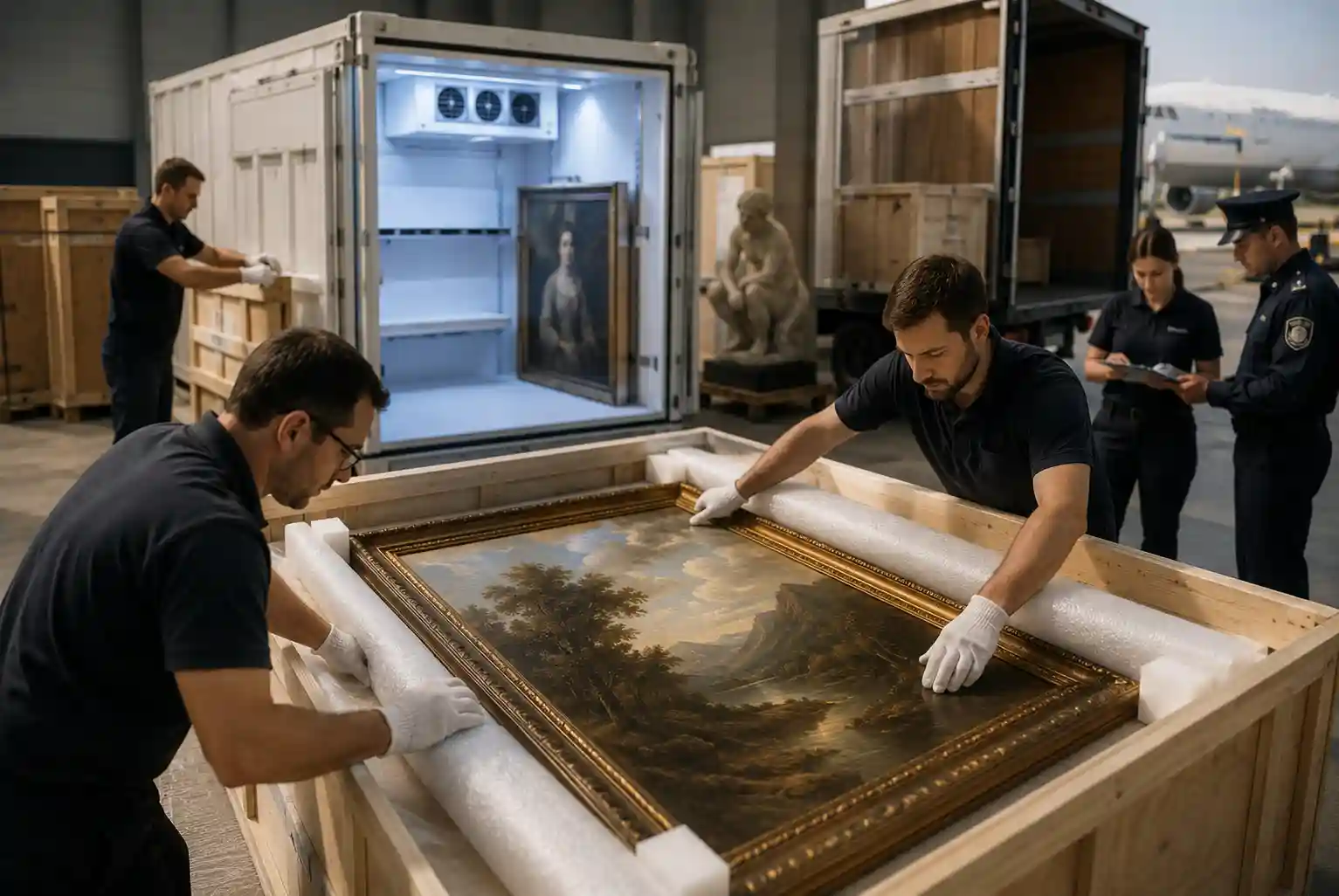
Relocating priceless masterpieces is a high-stakes endeavor where standard logistics fall dangerously short. For museums, galleries, and private collectors, transporting delicate works of art introduces profound vulnerabilities, ranging from microscopic road vibrations to sudden environmental shifts and bureaucratic delays. When contemporary pieces travel to events like the India Art Fair or the Kochi-Muziris Biennale, or when heritage antiquities cross international borders, the margin for error is zero. Navigating [ The Logistics of Fine Art Moving: Temperature Control, Bespoke Crating, and Customs Clearance] requires an intersection of conservation science, specialized engineering, and rigorous legal compliance. This comprehensive report details the mechanisms of fine art logistics, exploring how professional art transportation services mitigate physical and environmental risks, engineer museum-grade bespoke crating, and seamlessly manage complex customs clearance protocols to ensure the preservation of cultural heritage during transit.
The Science of Temperature Control and Climate-Controlled Shipping
Artwork is highly reactive to environmental fluctuations. When exposed to shifting temperatures and humidity levels, organic materials expand and contract, resulting in warped wooden frames, sagging canvases, and flaking paint. To prevent such deterioration, climate-controlled shipping establishes and maintains a precise microclimate throughout the transit lifecycle.
The Threat of Glass Transition Temperature (Tg)
A critical factor in fine art transport is managing the glass transition temperature (Tg) of the binding mediums used in paintings. The Tg is the specific temperature threshold at which a polymer transitions from a flexible, rubbery state into a brittle, glassy state.
- Acrylic paints, despite their flexibility at room temperature, possess a relatively high Tg of approximately 7°C to 10°C (45°F to 50°F). Dropping below this temperature causes the paint film to become highly susceptible to cracking.
- Alkyd paints reach their Tg around 1°C to 4°C.
- Oil paints are more resilient to cold, transitioning to a brittle state between 0°C and -25°C.
If a painting drops below its Tg during an international art relocation, routine physical handling or road vibrations can induce catastrophic craquelure—a permanent network of fine surface cracks.
Mitigating Relative Humidity and Off-Gassing
Simultaneous to temperature management, fine art logistics providers must aggressively regulate relative humidity (RH). Fluctuations beyond ±5% RH can induce differential expansion across the stratified layers of a painting. Table 1 outlines the widely accepted museum-grade environmental baselines for various mediums during transit and storage.
|
Material Category |
Ideal Temperature |
Ideal Relative Humidity (RH) |
|
Oil Paintings |
21°C - 24°C (70°F - 75°F) |
45% - 55% |
|
Watercolors / Paper |
20°C - 22°C (68°F - 72°F) |
50% - 55% |
|
Photographs |
18°C - 21°C (65°F - 70°F) |
30% - 40% |
|
Sculptures (Mixed) |
18°C - 21°C (65°F - 70°F) |
40% - 50% |
Furthermore, the materials used to house the art must not contribute to its degradation. Wood and open-cell foams naturally release volatile organic compounds (VOCs), such as acetic acid and formic acid, in a process known as off-gassing. These trapped VOCs act as corrosion agents inside a sealed crate. To combat this, specialized moving companies line their crates with vapor barriers such as Marvelseal 360 (an aluminized nylon and polyethylene film) and use inert, closed-cell foam to maintain a stable, non-reactive environment.
Bespoke Crating: Engineering Museum-Grade Protection
A critical pillar of fine art moving is the construction of custom-engineered wooden containers. Bespoke crating is not merely a wooden box; it is a multi-layered, shock-absorbing architecture designed specifically for the dimensions, weight, and fragility of the individual object.
The Three-Layer Protection Methodology
Professional art packers employ a stringent three-layer methodology to neutralize mechanical impact and environmental stress:
- Primary Surface Protection: The artwork's surface is shielded using acid-free glassine paper or silicone-coated Mylar to prevent abrasion and chemical bonding. For friable media like pastels or charcoals, anti-static acrylic glazing (such as Optium Museum Acrylic) is utilized. This glazing dissipates static charges almost instantaneously, preventing loose pigment from being pulled off the canvas.
- Cushioning and Bracing: The piece is floated within the crate using custom-cut, closed-cell polyethylene foams like Ethafoam or Plastazote. These materials do not permanently compress over time and provide exceptional shock absorption.
- Barrier and Structural Shell: The exterior shell is constructed from high-grade, AC-grade plywood, often coated in polycrylic sealant to repel external moisture.
Advanced Vibration Isolation
To combat the constant micro-vibrations of road and air transport, modern custom wooden crates frequently integrate advanced mechanical dampening systems. Studies indicate that integrating wire rope isolators within the crate's base can achieve vibration attenuation of up to -20 dB, particularly neutralizing the highly destructive 10–30 Hz frequency band generated by heavy transport vehicles.
ISPM 15 Compliance for Wood Packaging
When executing international art shipping, all wooden crates must be strictly ISPM 15 compliant. The International Standards for Phytosanitary Measures No. 15 dictates that raw wood thicker than 6mm must be debarked and subjected to heat treatment (HT) or methyl bromide (MB) fumigation to eradicate pests like the pinewood nematode. Crates must bear the permanent IPPC "wheat stamp" displaying the country of origin and treatment code. Failure to use ISPM 15-compliant wood will result in immediate rejection, delays, or destruction of the crate by destination customs authorities.
Navigating Customs Clearance and International Regulations
Customs clearance represents the most administratively fraught stage of global fine art logistics. Regulatory entanglements can cause sensitive shipments to stall on airport tarmacs, exposing them to catastrophic environmental risks. Successful cross-border movement demands exhaustive documentation.
Indian Regulations: The Antiquities and Art Treasures Act, 1972
For Indian art collectors and institutions, the export of cultural heritage is heavily regulated by the Antiquities and Art Treasures Act, 1972. By legal definition, any painting, sculpture, or crafted object older than 100 years, and any manuscript older than 75 years, is classified as an antiquity. The export of antiquities by private individuals is strictly prohibited.
To legally export modern and contemporary Indian art, fine art shippers must obtain a non-antiquity certificate from the Archaeological Survey of India (ASI). Under Section 24 of the Act, the ASI Director General's determination regarding an object's antiquity status is absolute and final. Attempting to export art without this certification can result in the seizure and absolute confiscation of the goods under Section 111 of the Customs Act, 1962.
Essential Global Shipping Documentation
- HS Codes and Taxes: Correct classification under the Harmonized System (HS) is vital. Original paintings and drawings fall under HS Code 9701, while original engravings and lithographs fall under HS Code 9702. In India, these items attract a 5% Integrated Goods and Services Tax (IGST). However, following recent regulatory changes, galleries and artists cannot claim an Input Tax Credit (ITC) on this 5% rate, slightly increasing baseline operational costs.
- ATA Carnet: For temporary exports—such as sending a piece to an international gallery or museum loan—logistics experts utilize an ATA Carnet. This international customs document allows duty-free and tax-free temporary admission, provided the artwork returns to its country of origin within one year.
- CITES Permits: If an artwork contains protected organic materials—such as rosewood, elephant ivory, or tortoiseshell, a CITES permit (Convention on International Trade in Endangered Species) is mandatory. Without proper provenance and export/import permits from the relevant CITES management authorities, the artwork is liable to be seized and destroyed at the border.
Evaluating Costs, Timelines, and Freight Options
The method of transportation heavily dictates the cost, timeline, and risk profile of the art relocation service. Selecting the appropriate modality requires balancing budget constraints against the fragility of the piece. Table 2 compares standard transit options for high-value artwork.
|
Freight Modality |
Average Cost (Medium Painting, EU/Intl) |
Typical Transit Timeline |
Risk & Use Case Profile |
|
Air Freight |
€800 – €1,500 |
3 – 5 Days |
Lowest risk of environmental exposure due to speed. Ideal for time-sensitive, high-value loans (>€100k). Relies on pressurized ULD containers. |
|
Sea Freight |
€400 – €800 |
2 – 6 Weeks |
Highly cost-effective but exposes art to prolonged climatic risks. Requires robust micro-climate crating and IoT sensor monitoring. |
|
Specialized Trucking |
€300 – €600 |
1 – 7 Days |
Standard for domestic or continental routes. Uses air-ride suspension and climate-controlled trailers. |
|
White-Glove Courier |
+€1,000 – €3,000 premium |
Variable |
A dedicated art handler accompanies the piece onboard flights (onboard courier) or dedicated vehicles. Mandatory for ultra-high-value museum pieces. |
Step-by-Step Procedure for Safe Art Relocation
To execute a flawless fine art transport, professional packers and movers adhere to a rigorous, sequential protocol:
- Pre-Move Condition Reporting: Before the artwork is touched, a detailed condition report is drafted. Conservators use raking light (oblique lighting) and UV fluorescence to document existing surface wear, fading, and prior restorations. High-resolution, timestamped photography establishes a baseline for liability.
- Custom Packing and Crate Fabrication: The piece is wrapped using acid-free materials and placed into a custom-engineered, ISPM 15-compliant crate, equipped with Ethafoam suspension blocks and moisture barriers.
- Active Transit Monitoring: During movement, data-logging sensors (e.g., ShockWatch or TiltWatch) are embedded in the crate to actively record temperature, humidity, and tri-axial shock impacts.
- Tarmac Supervision: For international air freight, specialized couriers provide tarmac supervision to ensure crates are not left exposed to extreme weather elements while waiting to be loaded into the aircraft.
- The 24-Hour Acclimation Period: Upon delivery, the crate must undergo a mandatory 24-hour dwell time. This allows the internal microclimate to gradually equalize with the new room temperature, completely preventing condensation and thermal shock upon opening.
Securing Fine Art Transit Insurance
Standard freight liability policies are fundamentally flawed for fine art moving. Freight liability is fault-based (meaning the carrier must be proven negligent) and payouts are often capped by weight, such as $0.60 per pound under standard regulations. A ten-pound painting worth millions would receive a mere six dollars in compensation.
Consequently, securing specialized fine art transit insurance (Cargo Insurance) is imperative. The industry standard is wall-to-wall insurance (also known as nail-to-nail coverage). This comprehensive, all-risk policy protects the artwork continuously from the moment it is taken off the wall at the origin, throughout all intermediary storage and transport phases, until it is safely installed at the final destination. Insurance premiums generally cost between 1% and 3% of the artwork's appraised value, depending on the route and packing quality.
Common Mistakes to Avoid in Art Logistics
- Using Non-Archival Packing Materials: Directly wrapping paintings or metal sculptures in standard bubble wrap can cause the plastic to chemically bond with the surface, leaving irreversible imprint patterns.
- Ignoring the Dwell Time: Opening a cold crate immediately in a warm gallery causes rapid condensation, which can permanently stain and warp canvas fibers.
- Failing to Secure Proper Documentation: Shipping without an ASI non-antiquity certificate in India or omitting required CITES permits internationally will result in severe customs delays, fines, or permanent confiscation of the artwork.
- Underinsuring the Shipment: Relying on a standard carrier's weight-based liability rather than purchasing all-risk wall-to-wall insurance leaves the collector fully exposed to financial devastation.
Why Professional Relocation Services Can Help
The intricacies of fine art logistics extend far beyond the capabilities of standard household moving companies. Engaging expert relocation services simplifies the process, ensuring that the physical and financial integrity of the artwork remains uncompromised.
Elite fine art movers are typically audited members of ICEFAT (International Convention of Exhibition and Fine Art Transporters). These organizations must pass stringent Ernst & Young audits verifying their building security, climate-control capabilities, and chain-of-custody protocols. Professional art handlers operate with a minimum of two-person crews to guarantee that high-value cargo is never left unattended. They seamlessly coordinate the fabrication of bespoke crating, manage optimal climate-controlled shipping, secure robust transit insurance, and navigate the labyrinthine legalities of international customs clearance. By utilizing a specialized logistics provider, collectors, galleries, and museums can transfer the burden of risk entirely to trained professionals.
Conclusion
The successful transit of high-value artwork hinges upon mastering [ The Logistics of Fine Art Moving: Temperature Control, Bespoke Crating, and Customs Clearance]. Understanding the thermodynamics of paint materials, mitigating vibration through advanced crate engineering, and preemptively navigating strict regulatory frameworks are non-negotiable prerequisites. By avoiding standard packing errors, adhering to strict acclimation protocols, and securing comprehensive transit insurance, stakeholders can prevent catastrophic damage. Ultimately, partnering with ICEFAT-certified fine art logistics experts ensures that irreplaceable cultural heritage and significant financial investments are safeguarded across every mile of their journey.
Frequently Asked Questions (FAQs)
1. What exactly is fine art logistics?
Fine art logistics refers to the specialized sub-sector of the moving industry dedicated to the safe packing, handling, transportation, and storage of valuable artworks, sculptures, and historical artefacts. It relies on museum-grade packing, climate-controlled transport, and specialized security protocols.
2. Why is strict temperature control critical when moving paintings?
Artworks are highly vulnerable to thermal shock. If a painting drops below its glass transition temperature (Tg), the binding medium becomes glassy and brittle, making it highly susceptible to cracking (craquelure) during transit vibrations. Maintaining a stable 18°C–21°C environment prevents this brittleness.
3. What does it mean for a crate to be ISPM 15 compliant?
ISPM 15 compliant indicates that the solid wood used to build a shipping crate has been heat-treated or fumigated to eradicate insects and pests. It is a mandatory international regulation; custom crates lacking the official IPPC "wheat stamp" will be rejected or destroyed by customs authorities.
4. How do I export modern art or paintings from India?
To legally export modern artwork from India, the shipper must comply with the Antiquities and Art Treasures Act, 1972. The exporter must obtain a non-antiquity certificate from the Archaeological Survey of India (ASI) proving the item is not a restricted historical antiquity. Without this, customs will not clear the shipment.
5. What is an ATA Carnet and when is it used?
An ATA Carnet is an internationally recognized customs document that functions as a "passport for goods." It allows for the temporary, duty-free, and tax-free import of artworks, making it essential for international museum loans or global art fair exhibitions.
6. What is the difference between standard freight liability and wall-to-wall insurance?
Standard freight liability is fault-based and typically reimburses based on the weight of the item (e.g., $0.60 per pound), which is useless for art. Wall-to-wall insurance (or nail-to-nail coverage) is an all-risk policy that covers the full appraised value of the art continuously from the moment it leaves its origin wall until it is hung at its final destination.
7. Why do art handlers wait 24 hours before opening a delivered crate?
This mandatory 24-hour resting period, known as "dwell time" or acclimation, allows the microclimate inside the crate to slowly equalize with the temperature and humidity of the destination room. Opening a cold crate immediately in a warm room causes rapid condensation, which can permanently damage the artwork.
Our Blogs

HOW TO MOVE TO JAPAN FROM INDIA: A COMPLETE RELOCATION GUIDE
Planning to move to Japan from India? This detailed relocation guide covers everything you need to know before making the move, including Japan visa requirements for Indians, Certificate of Eligibility, moving costs, air and sea freight options, customs clearance, shipping household goods, finding accommodation, managing living expenses, and completing important arrival formalities. It also includes practical budgeting tips, a pre-move checklist, and helpful guidance to make your relocation to Japan smoother, more organized, and stress-free with professional international moving support.

THE FIRST 24 HOURS AFTER MOVING: WHAT SHOULD YOU UNPACK AND SET UP FIRST?
Moving into a new home can feel overwhelming, especially when you are surrounded by boxes and do not know where to start. This guide explains what to unpack first after moving and how to organize your first 24 hours. From checking safety and utilities to setting up the bathroom, bedroom, kitchen, clothes, and daily essentials, follow a simple order to make your new home comfortable and functional without unnecessary stress.

MOVING INTO A HIGH-RISE? THE RELOCATION PROBLEMS NOBODY WARNS YOU ABOUT
Moving into a high-rise apartment comes with challenges most people do not expect. From lift bookings and parking limits to bulky furniture, building rules, and moving delays, discover the hidden problems of high-rise relocation and how to plan a smoother, safer move.
 Post Feedback
 Gallery
 Awards & Media
 FAQ
FAQ CSR & Sustainability
.svg)